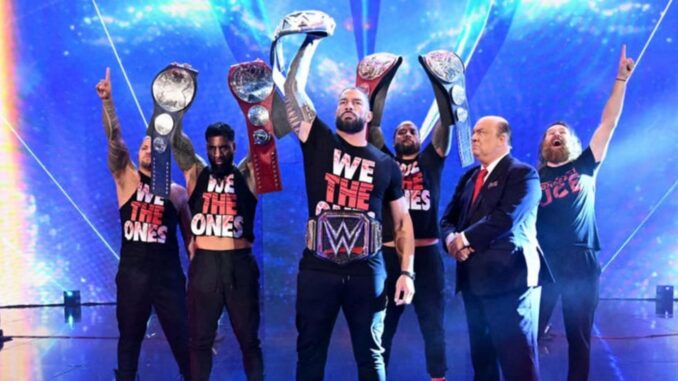
For nearly four years, WWE rode one of the greatest storylines in professional wrestling history. The Bloodline saga wasn’t just another championship angle—it became the emotional centerpiece of the entire company. Roman Reigns’ historic title reign, the rise of Sami Zayn, Jey Uso’s internal conflict, Cody Rhodes’ pursuit of “finishing the story,” and the eventual collapse of the family created must-see television on a weekly basis.
Now that the story has largely reached its conclusion, WWE finds itself facing a challenge that every wrestling promotion eventually encounters: How do you follow something that became bigger than the company itself?
The answer is proving to be much more difficult than fans may have expected.
Success Creates an Impossible Standard
The Bloodline wasn’t simply WWE’s top storyline. It was the storyline.
Every major premium live event revolved around it. Every episode of SmackDown felt like it could feature another memorable chapter. Even fans who weren’t invested in the rest of the card tuned in because they wanted to see what happened next with Roman Reigns, The Usos, Solo Sikoa, Paul Heyman, or Cody Rhodes.
That level of anticipation is incredibly rare in professional wrestling.
Now, WWE’s weekly television is still producing quality matches and entertaining segments, but there isn’t a single storyline carrying the same emotional weight. Instead of one overarching narrative connecting everything together, fans are watching several good stories that simply don’t feel as essential.
That’s not necessarily bad booking.
It’s simply what happens after an all-time great storyline ends.
History Has Seen This Before
This isn’t the first time wrestling has experienced this phenomenon.
WCW After the nWo
In 1996, the New World Order completely transformed professional wrestling.
Hulk Hogan’s heel turn shocked the industry, Kevin Nash and Scott Hall became the coolest villains in wrestling, and WCW suddenly became the hottest promotion in the world.
For nearly two years, Nitro felt must-watch every Monday night.
But eventually, the story reached its natural conclusion.
Instead of ending the angle cleanly, WCW stretched it out with endless nWo factions, confusing alliances, and repetitive booking. The storyline that once made WCW feel revolutionary became the very thing that dragged the company down.
The promotion struggled to create another storyline capable of replacing the cultural phenomenon that was the nWo.
WWE After Austin vs. McMahon
The Attitude Era tells a similar story.
Stone Cold Steve Austin versus Vince McMahon wasn’t just wrestling’s biggest rivalry—it became one of television’s defining feuds.
Every week fans tuned in to see what Austin would do next to embarrass his tyrannical boss.
Beer trucks.
Zambonis.
Hospital attacks.
Corporate screwjobs.
It consistently delivered unforgettable television.
As Austin’s full-time career slowed due to injuries and the rivalry naturally wound down, WWE still featured incredible talent like The Rock, Triple H, Kurt Angle, Chris Jericho, and Brock Lesnar.
Yet many fans agree that the product never quite captured the same lightning-in-a-bottle feeling that Austin versus McMahon created.
Business remained strong for a time, but recreating that weekly anticipation proved impossible.
WWE’s Current Situation Feels Familiar
Today’s WWE isn’t suffering from poor booking.
In fact, many aspects of the current product are excellent.
The in-ring wrestling is arguably the best it’s ever been.
The roster is loaded with established stars and emerging talent.
Production quality remains elite.
Business numbers are still impressive.
But emotionally, something feels different.
The Bloodline gave fans a reason to watch every single week because every interaction mattered. Every facial expression, every betrayal, and every conversation could move the story forward.
Current rivalries simply don’t possess that same long-term investment.
Instead of asking, “What happens next?” many fans are simply asking, “Who’s wrestling tonight?”
That’s a significant difference.
Building the Next Mega Story Takes Time
One mistake fans often make is expecting another legendary storyline to appear immediately after the previous one ends.
That’s rarely how wrestling works.
The Bloodline wasn’t special because WWE planned it from Day One.
It evolved.
Roman Reigns’ Tribal Chief character developed over time.
Jey Uso unexpectedly became one of wrestling’s best dramatic performers.
Sami Zayn’s involvement elevated the story to another level.
Cody Rhodes’ pursuit added the perfect ending.
None of those elements were guaranteed when the storyline first began.
Likewise, WWE’s next defining storyline may already be quietly developing.
Perhaps it’s Jacob Fatu’s rise.
Maybe it’s the continued evolution of Gunther.
Perhaps it’s a future rivalry involving Bron Breakker, Cody Rhodes, CM Punk, or another emerging star.
Nobody knew in 2020 that The Bloodline would become one of wrestling’s greatest stories.
Patience Is Part of Great Storytelling
Wrestling fans often judge weekly television against the very best moments in wrestling history.
That’s an impossible standard.
Not every era can produce an Austin vs. McMahon.
Not every generation will have an nWo.
Not every decade will feature something as compelling as The Bloodline.
Those stories become legendary precisely because they are rare.
WWE isn’t necessarily “cold” today. The company is simply experiencing what nearly every wrestling promotion experiences after completing a once-in-a-generation storyline.
The challenge now isn’t maintaining the success of The Bloodline.
It’s creating the next story that makes fans feel they absolutely cannot miss next week’s show.
History shows that’s one of the hardest things in professional wrestling—and it usually takes longer than anyone expects.
